Real people, real prizes and one very public learning curve…
Building Legion Comps in public: the wins, the mistakes, the lessons, and what we’re changing as we learn how to do competitions properly.

Rob told you last week how Legion Comps began over a few beers, how he built an entire competition platform from scratch and how our first round of draws aged us both by approximately fourteen years.
This week, it’s my turn.
That is either because we believe both founders should contribute, or because Rob wants written evidence that this week’s problems were definitely mine.
1. A quiet second week would have been nice
After completing our first draws successfully, I imagined week two would be fairly straightforward.
We would pack the prizes, post some content, welcome a few new customers and calmly watch the business grow.
Some of that happened.
We also discovered that the Warhammer community can identify an AI-generated founder from approximately three scrolls away.
2. The AI image incident
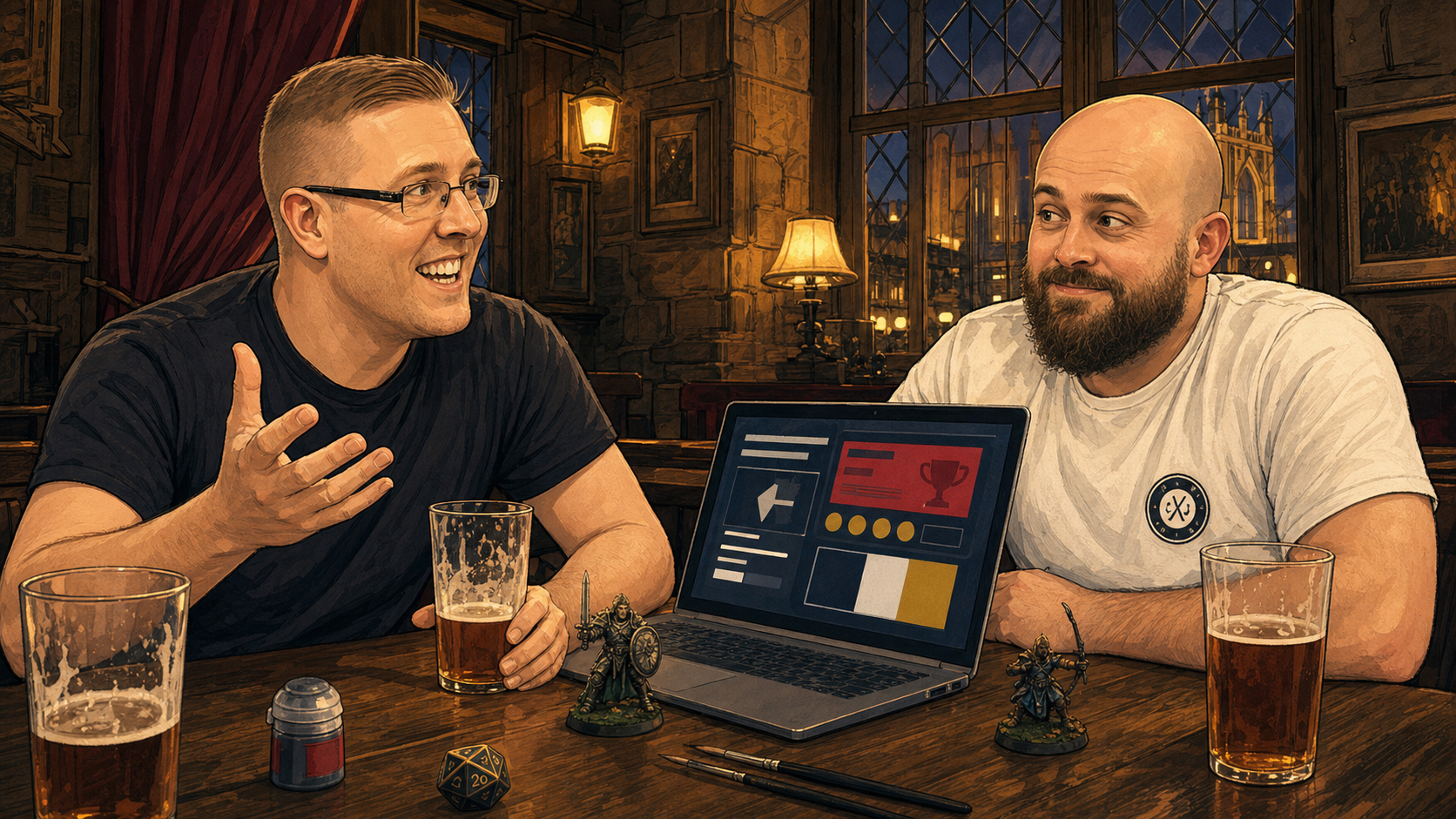
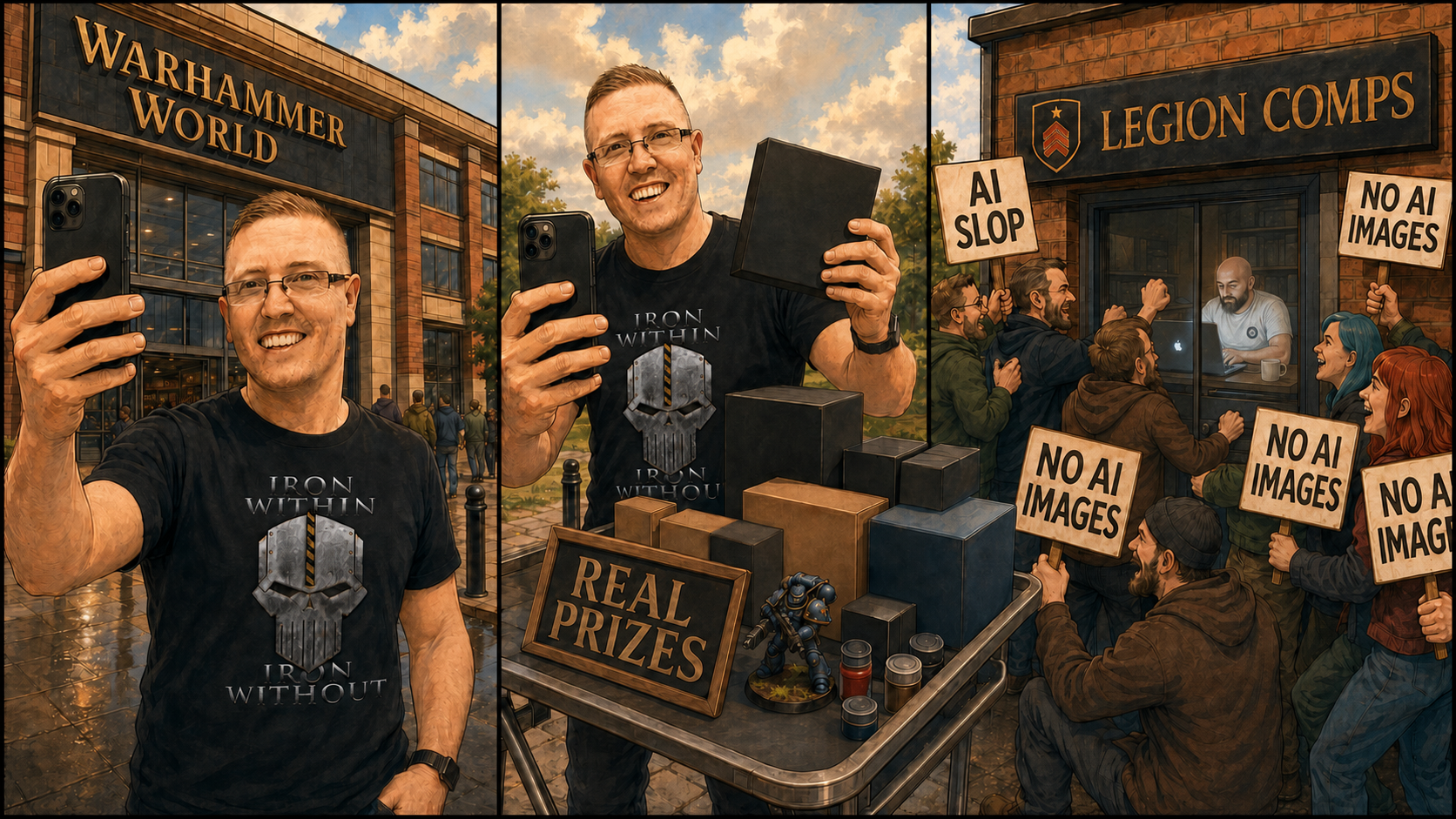
For our first War Table article, we used an AI-generated illustration of Rob and me sitting in a pub booth.
It was intended as a light-hearted way of showing how Legion Comps began: two hobbyists, a few beers and one slightly ambitious business idea.
Unfortunately, it didn’t land as intended.
Some people quite rightly pointed out that if we were asking customers to trust a brand-new business, they wanted to see the real people behind it not computer-generated versions of us.
That was a fair criticism.
The image was never intended to be presented as a genuine photograph, but intention doesn’t change how something is received. It was my decision to use it, so I took the feedback on the chin.
The lesson was simple: people need to see the actual people and products behind Legion Comps.
From now on, we’ll be sharing more genuine photographs, videos, product showcases, packing updates and behind-the-scenes content. If we use an illustration for a joke or an article, it will be unmistakably presented as an illustration rather than a substitute for showing the real business.
It sounds obvious when written down.
Most good lessons do.
3. A completely legitimate business trip
After the image drama, there was only one sensible response.
I went to Warhammer World.
Officially, this was a content and research trip for Legion Comps.
Unofficially, sending an Iron Warriors fan into a building full of enormous displays, painted armies and shelves of miniatures is a bit like sending an Ork into a scrapyard and asking him only to take notes.
I filmed videos outside, showcased some of the products and gathered plenty of ideas for future prizes.
Meanwhile, poor Rob remained behind the computer keeping the platform running while receiving a steady stream of photographs and increasingly expensive examples of “market research”.
More importantly, the visit brought me back to why we started Legion Comps in the first place.
We don’t want to offer random collections of plastic selected by somebody staring at a spreadsheet. We want prizes that make sense to hobbyists: complete projects, themed bundles, useful primers, transfers, tools, painted miniatures and products somebody would genuinely be excited to receive.
Warhammer World is very good at reminding you how much this hobby means to people.
It is also very good at making “market research” unexpectedly expensive.
4. The best part of the week
Among all the noise, something genuinely brilliant happened.
Our first six winners were drawn.
Emails were sent, addresses were confirmed and the first prizes began making their way towards their new homes.
Until that moment, everything had existed on a screen: competition pages, ticket numbers, dashboards and photographs.
Then suddenly there were actual prizes on a packing table with real winners waiting for them.
That made the business feel real in a completely different way.
Some of our launch competitions had sold far fewer tickets than we hoped. We knew running the draws would mean taking a financial loss, but the advertised dates were the advertised dates.
People had trusted us with their entries, so every promised draw went ahead.
No extensions. No rollovers. No quietly moving the finish line because the numbers weren’t where we wanted them to be.
The website worked. Our independently verifiable draw system selected the winners, and six people became the first names in Legion Comps history.
That felt considerably better than looking at the profit column.
5. Growth, just not the overnight kind
Legion Comps has not suddenly gone viral.
There isn’t an army of thousands waiting outside the website every morning. Some days bring new entries, followers and conversations. On other days, the dashboard does an extremely convincing impression of an abandoned tomb world.
But the business is growing.
More people are finding the site. Our social following is increasing, people outside our immediate circle are entering and some customers are returning for the next round.
We have also become verified by Rafflers, adding another independent trust marker to the site.
Those might sound like small victories, but for a completely new business, they matter.
Every new follower, entrant, review and shared post represents somebody who had never heard of Legion Comps a couple of weeks ago.
Week one produced a grape.
Week two might have produced a small bunch.
We are not opening a vineyard just yet.
6. People need to see the people
The criticism of our original War Table illustration reinforced something we had already started to realise.
People need to see who is behind the business.
Rob is responsible for the platform, security and the complicated technical systems that make the competitions and draws work.
I focus on the hobby, the prizes, the community and—apparently—the occasional social-media incident.
Together, we’re two hobbyists trying to build something worthwhile while balancing work, families and all the normal responsibilities that stubbornly continue to exist when you start a business.
You’ll therefore be seeing more of us: more videos, genuine product photography, packing updates, winner announcements, Warhammer trips and behind-the-scenes posts.
Unfortunately for everyone, this means considerably more of my face.
Rob will usually be somewhere in the background, staring into a computer and wondering what I have promised people now.
7. What week two taught us
The platform working is only one part of running Legion Comps.
The other part is earning trust.
That means showing the real prizes, introducing the real people behind the business, writing clear descriptions, responding properly when somebody raises a concern and keeping every promise even when doing so costs us money.
We made a mistake with the illustration used for our first War Table article.
We acknowledged it, listened to the feedback and changed our approach.
We completed our first draws and began dispatching prizes to six winners.
We visited Warhammer World, filmed genuine content and returned with enough future prize ideas to worry Rob.
We welcomed new customers, gained independent verification and became a little more established than we had been seven days earlier.
It wasn’t a perfect week.
It was, however, progress.
So, was week two a success?
The people are real.
The prizes are real.
The winners are real.
The growth is real.
The tiredness is extremely real.
Week one proved that the platform worked. Week two reminded us that a brand has to earn people’s confidence every single day.
We are still learning, still improving and still determined to build a competition site that genuinely belongs in the hobby community.
The small AI robot in the marketing department remains on probation and is now only permitted to draw cartoons under adult supervision.
Rob remains at the computer.
See you in week three.
Probably.
Iron Within. Iron Without.